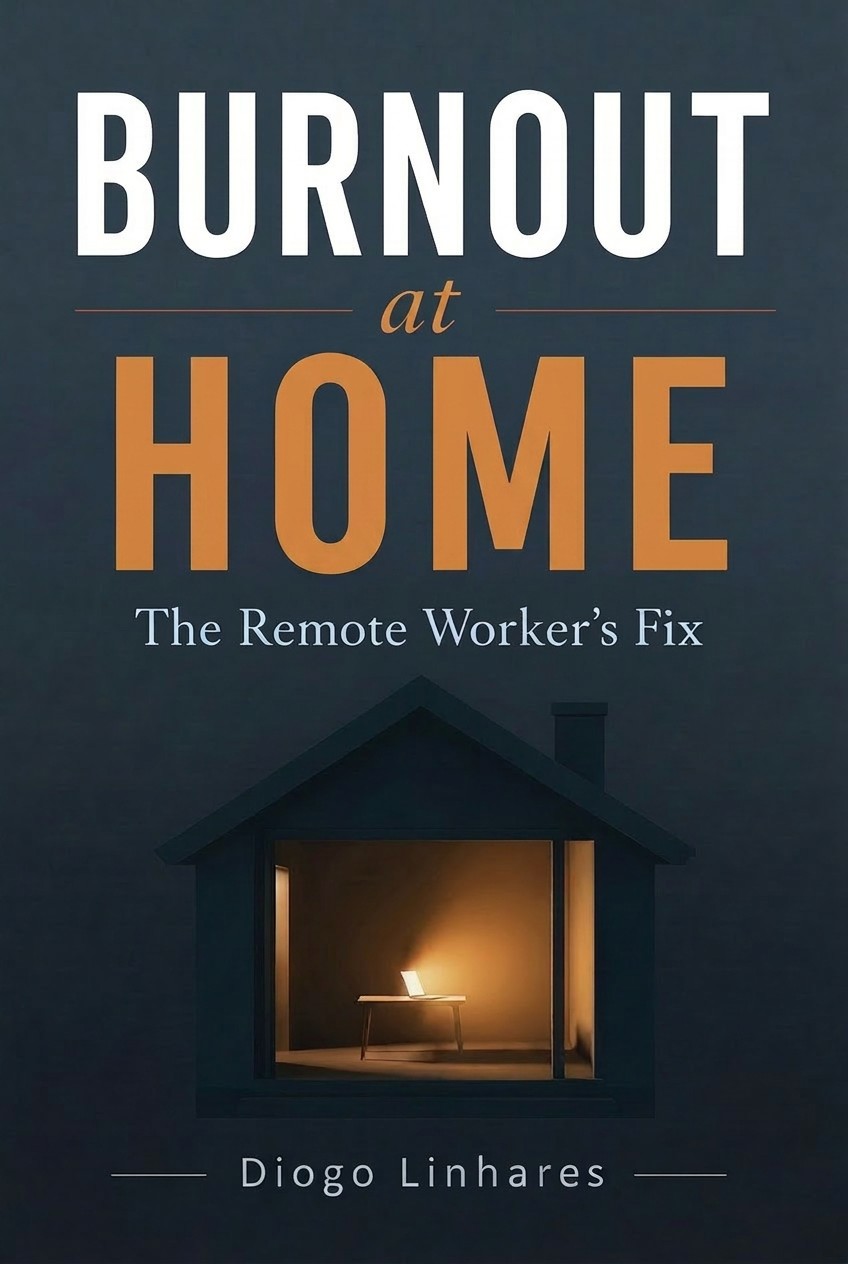
Companion Workbook
The Remote Worker's Fix
Diogo Linhares
A field manual, not a test. There are no right answers — only honest ones.
Part One
The Trap
Chapters 1–3 · Understanding how you got here
Part Two
The Break
Chapter 4 · Diagnosing your burnout fingerprint
Part Three
The Reset
Chapters 5–10 · Building the practical system
Part Four
The New Normal
Chapter 11 · Making the system last in any setting
A quick self-check before the work begins. Write quickly and honestly.
Three honest sentences
Don't filter. Write what is actually true — not the version you'd say in a performance review.
See where work has crossed into life — the moments you handed over time that was supposed to belong to something else.
Map your boundary leaks
List the specific moments when work regularly enters your personal time. Be concrete — a vague "I work too much" is not useful. "I check Slack after dinner on weeknights" is.
| The leak | When it happens | What it costs you |
|---|---|---|
Name the triggers that prevent your nervous system from switching off — even when you've stopped working.
Activation map
For each factor, rate how much it keeps you mentally on. Circle or select your level: Low / Medium / High.
| Activation factor | My level | How it shows up for me |
|---|---|---|
| Late pings — messages outside work hours | ||
| Open loops — unfinished tasks, unclear priorities | ||
| Social pressure — feeling I must reply instantly | ||
| Performance fear — fear of being seen as slow or unavailable | ||
| Habit loops — automatic checking, inbox refreshing |
Turn "I think I work too much" into a concrete number. What gets measured gets changed.
Daily log (repeat for 3 days)
| When | What happened | Trigger | Category | Minutes |
|---|---|---|---|---|
Your numbers
Find your specific burnout pattern. The wrong diagnosis leads to the wrong fix.
Exhaustion
Cynicism
Inefficacy
Map what's competing for your attention, then design the environment your best work actually needs.
Step 1 · Digital Noise Inventory
Over three workdays, list every tool, app, and channel that can reach you. Classify each as Essential, Useful, or Noise.
| Tool / channel | Checks/day | Category | Decision |
|---|---|---|---|
Step 2 · Digital Minimum Protocol
Using your inventory, define the rules for each layer of your digital environment.
Design your repeatable off switch — the habit that does what the old commute used to do for free.
Design your three-stage ritual
Must involve your body and happen in a different physical space than your work setup.
Write the words before you need them. Prepared scripts remove the hesitation that makes these conversations feel risky.
Script 1 · Manager conversation
Lead with performance. Be specific about hours and escalation. End by inviting their perspective. Draft your version below — adapt the language to your voice.
Script 2 · Team message
Written or spoken. Short, clear, positions your limits as a team benefit — not an individual preference.
Script 3 · Client / external partners
For key relationships where the pattern has been heavily always-on. Brief, professional, no apology.
Preparing for pushback
If your manager responds with "I need you always available," ask these before assuming the worst.
| Question to ask | Their response (notes) |
|---|---|
| "Can you share a concrete example where waiting until the next morning would cause serious issues?" | |
| "How often does that kind of situation actually happen?" | |
| "If we keep the emergency channel available, would that address most cases?" |
Use READ only for messages that carry emotional charge — the ones that make your body react before your mind has fully read them.
R
Regulate
Lower your activation before touching the keyboard. Sometimes this takes a breath. Sometimes it takes closing the laptop and calling it a day. That is not avoidance — it is judgment.
E
Evaluate
Name your state honestly. Tired? Angry? Defensive? Afraid? You're usually less confused than you think — just moving too fast to name what's true.
A
Assess
Now assess the message itself. Is this truly urgent or merely uncomfortable? Does it need a full reply now, a brief acknowledgment, or nothing until tomorrow?
D
Deliver
Only now do you respond. Aim for clarity, calm, and closure. A good async reply reduces the amount of communication required after it — not more of it.
7-Day Experiment Log
For the next seven workdays, use READ only when a message triggers a physical reaction — jaw tightening, breathing shortening, body bracing. Not every message. Just those ones. Log each instance below.
| Date | What triggered it | State (E/C/I) |
What I chose to do | What happened |
|---|---|---|---|---|
End-of-week reflection
Answer these four questions after completing the 7-day log. Be specific — "it went okay" is not useful data.
Replace passive rest with restorative rest — and build the weekly rhythm that actually starts repaying your recovery debt.
Passive rest vs. restorative rest
The four ingredients of real recovery: psychological detachment, relaxation, mastery experiences, social connection. List what genuinely restores you and what only feels like rest.
| Genuinely restores me | Feels like rest but doesn't restore | I'm cutting or limiting |
|---|---|---|
Weekly Recovery Protocol
Decide in advance. Ambiguity keeps your brain on low-level alert all weekend.
Systems drift. This check-in is how you bring yours back — every month, without self-criticism.
Monthly check-in (repeat each month)
| Date | What slipped? | What worked well? | What the month told me | What I'll reset |
|---|---|---|---|---|
Red / Yellow / Green week log
Green = full system runs. Yellow = slight flex, core intact. Red = true crunch, time-boxed with a reset date.
| Week of | Type | What flexed | Reset plan |
|---|---|---|---|
30 / 60 / 90-Day Maintenance Plan
Use one column for each milestone. Be specific about what you'll protect and what conversations you'll have.
30 days
60 days
90 days
Your system is not location-dependent. These exercises help you carry it into a hybrid or in-office setting — and decide clearly what to do if the policy doesn't fit your life.
Step 1 · Identify your starting point
Which profile describes you most honestly right now? These aren't permanent labels — they're lenses for making a clear decision.
| Profile | What it means | Check if this is you |
|---|---|---|
| The Adapter | The arrangement is workable. Your question is: how do I bring my system with me without sliding back? | |
| The Negotiator | The policy as written doesn't work, but you'd stay if it could be modified. You have a business case to make. | |
| The Decision Maker | The new setup is fundamentally incompatible with how you can sustainably work. Staying isn't the rational choice. |
Step 2 · What your system carries over
Your Digital Minimum, Shutdown Ritual, async skills, and boundaries don't disappear because the location changed. Map what transfers directly.
| System element | How it transfers to office / hybrid | What I need to protect |
|---|---|---|
| Digital Minimum | ||
| Shutdown Ritual | ||
| Communication Hours | ||
| Deep Work Blocks |
Step 3 · Design your transition ritual
The commute is liminal space. Used deliberately, it's one of the most practical levers you have. Decide in advance what it's for — or it defaults to an extension of the workday.
For Negotiators — performance case builder
Position flexibility as a business decision, not a lifestyle request. Prepare before the conversation.
Not a promise to be perfect. A decision to always return.
Complete this page when you've finished Part Three. Return to it when you drift.
Burnout at Home: The Remote Worker's Fix
Diogo Linhares · burnoutathomebook.com/workbook
This workbook is the official companion to the book. Fill it in your browser, print it, or save as PDF using the button in the corner.
All exercises correspond to the 11-chapter final manuscript.